
How smoothly will leadership transfer when ownership changes?
Explore how Staevra examines responsibility distribution, leadership capacity, and the operating conditions that may affect a business's ability to function beyond its founder.
Before the transaction. Through the transition. Beyond the founder.
For M&A advisers, exit strategists, and the owners they guide.
Ownership can transfer. Founder dependency can remain.
A business can generate revenue while depending on one person to make decisions, stabilize teams, resolve exceptions, and hold institutional knowledge.
For an adviser, the question is not simply whether the owner plans to exit. It is whether leadership responsibilities can be carried by the organization with less direct founder intervention.
Staevra provides a structured way to investigate these conditions. It is not a business valuation, transaction-readiness certification, or substitute for operational due diligence.
Where does the business still depend on the owner?
Which decisions, escalations, and relationships return to the founder?
Who can sustain execution?
Are authority and accountability actually distributed?
What needs to change before or after transition?
Which leadership conditions warrant closer examination and verification?
Two responsibilities.
One leadership architecture.
The model distinguishes the distribution of vision from the distribution of operations. The founder does not disappear. The founder's responsibility changes.
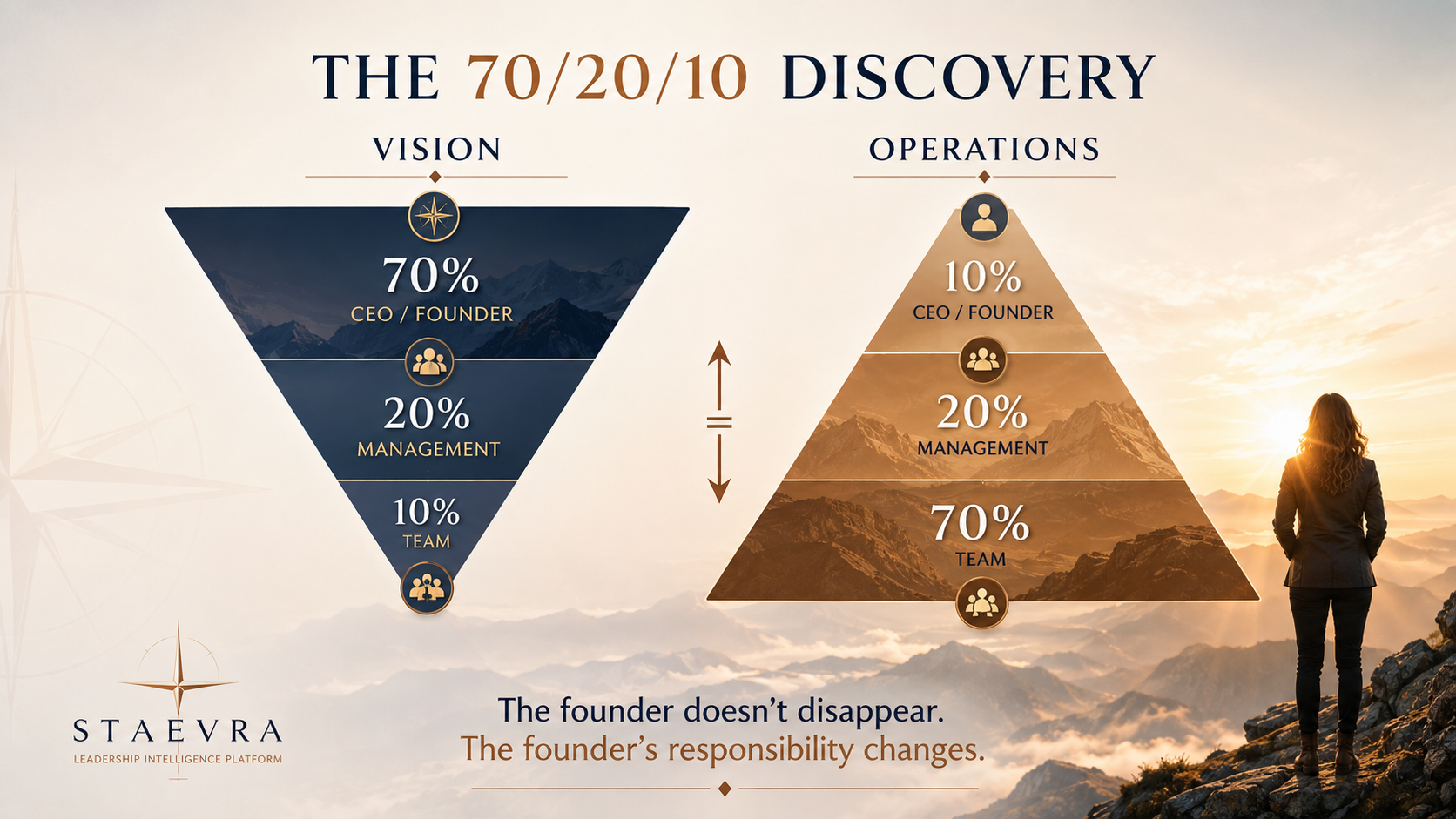
Reference allocations from the Staevra 70/20/10 Leadership System. These are framework targets, not measured business performance or universal benchmarks.
Explore responsibility by layer
Choose a responsibility type and a leadership layer to see what the framework asks you to examine.
Hold strategic direction
The founder's primary role in vision is to define direction, future positioning, and consequential choices rather than personally execute every decision.
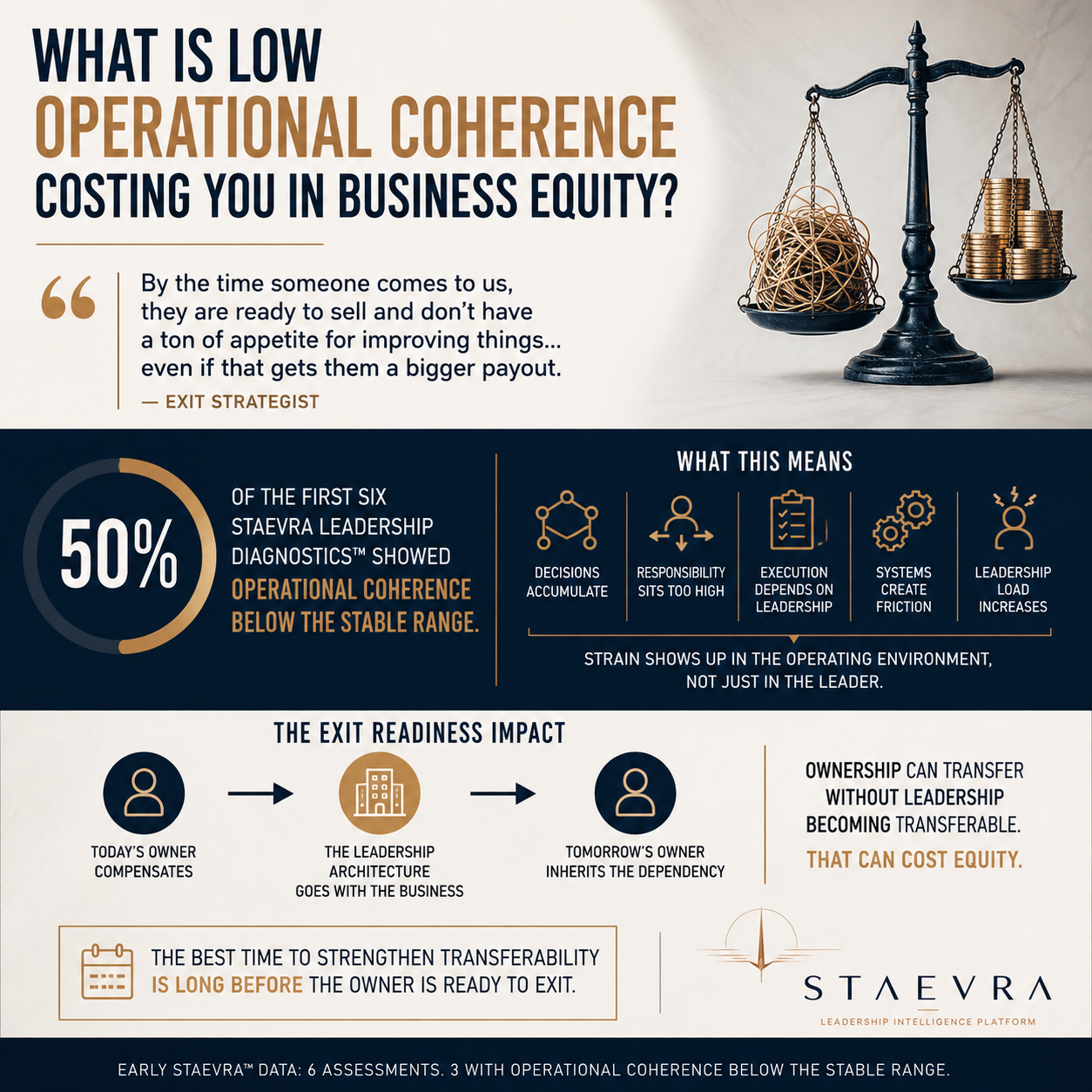
Operational structure and leadership capacity must support each other.
The Dual Leadership Coherence Rule™ examines whether the leader's energetic leadership pattern is supported by the organization's distribution of responsibility, or whether the leader is compensating for the structure.
Operational Coherence
Where responsibility resides across the Strategic, Stabilizer, and Execution layers, including the concentration of decisions, management support, and delivery ownership.
Energetic Coherence
The leader's reported leadership rhythm and capacity, considered through observable patterns such as urgency, overfunctioning, decision load, recovery, adaptability, and sustained attention.
Energetic Coherence is Staevra's interpretive terminology, not a claim to measure a physical energy field.
Is the leader supported by the system, or compensating for it?
Strong individual capacity can coexist with concentrated decisions and weak execution ownership. A functioning operation can also mask the cost of constant executive intervention.
Explore the four Energetic Leadership cycles
Starts movement and sets direction
Operational support: Clear execution ownership and decision rights
Potential mismatch: Initiating without sufficient execution ownership can leave the founder carrying implementation.
From reported conditions to a structured leadership conversation.
Staevra draws together several perspectives on the leader and the operating environment. These are assessment-derived signals that inform interpretation, not direct observation of every organizational outcome.
Builder Lens
How a leader approaches decisions, information, and complexity, alongside the current Energetic Leadership cycle.
Operational leadership
Strategic, Stabilizer, and Execution responsibility, including signs of concentration or under-distribution.
Coherence & strain
Operational Coherence, Energetic Coherence, primary strain drivers, and potential recalibration needs.
How do the 17 framework rules fit together?
Rule #17, the Dual Leadership Coherence Rule™, is the core diagnostic rule. Rules #1–16 are supporting interpretive rules that help contextualize patterns such as communication, team efficiency, prioritization, client retention, and resource allocation. The page intentionally does not publish proprietary calculations or internal rule-selection logic.
Can partners and key team members participate?
Individual assessments can be completed by additional participants. Their perspectives may be considered together manually during an Executive Debrief. This is not presented as automated multi-rater scoring or verified team consensus.
What does the assessment not establish on its own?
It does not independently verify revenue continuity, execution throughput, financial value, or transaction outcomes. Self-reported findings are best examined alongside operational records, financial measures, and perspectives from relevant stakeholders.
See the intelligence in context.
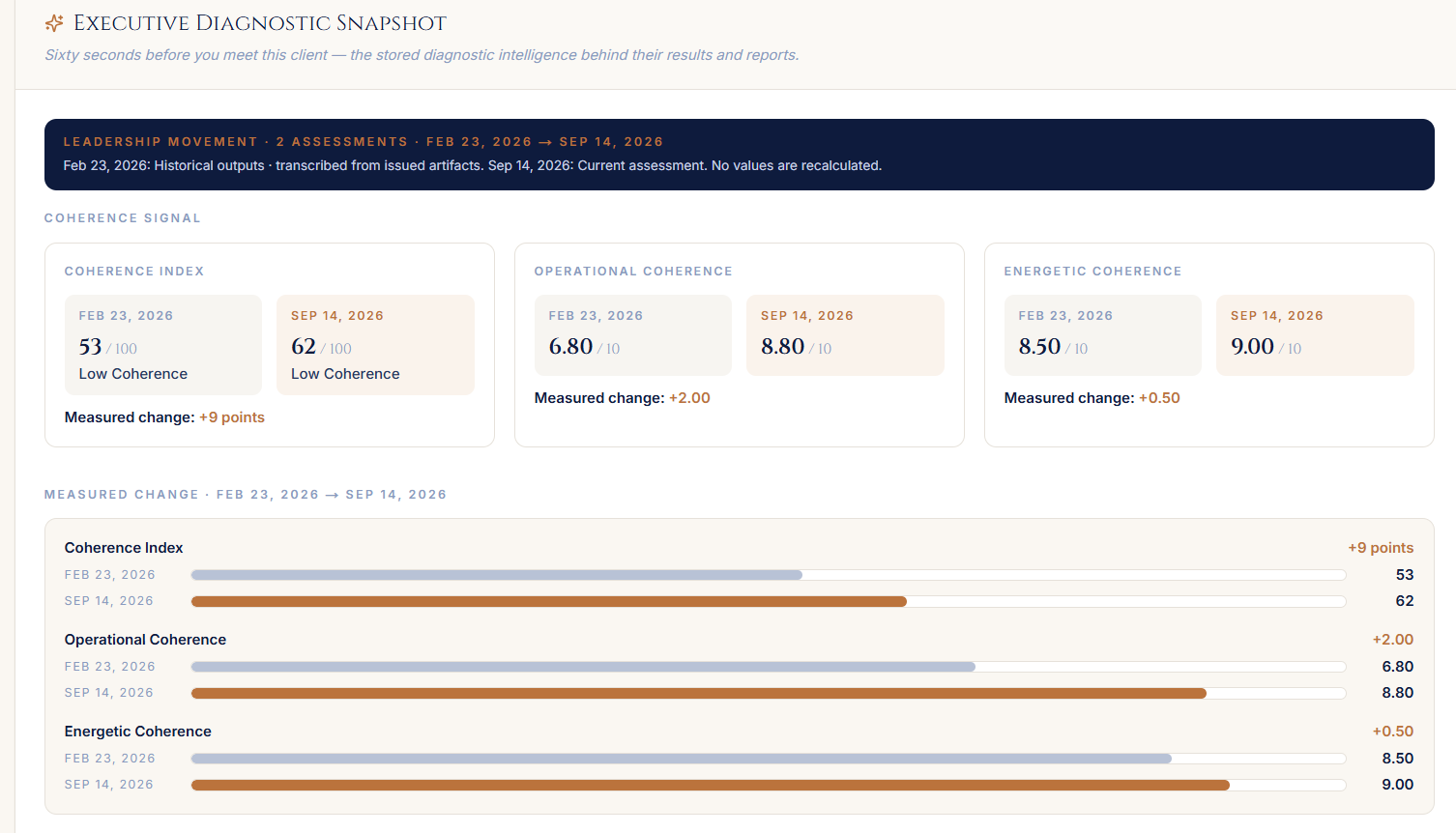
Five selected views illustrate how Staevra connects leadership architecture, responsibility distribution, coherence movement, and actionable priorities. Select any image to inspect it at a larger size. Screenshots illustrate the product experience; report formats may evolve.


Make the next leadership decision more precise.
The Executive Debrief connects assessment patterns to the business context. A 90-day Leadership Arc can organize priorities for investigation, ownership clarification, and reassessment.
Identify the concentration
Where are decisions, escalations, or stabilizing responsibilities accumulating?
Clarify the handoff
What authority, role ownership, operating rhythm, or documentation would make execution more independent?
Review what moved
Which reported conditions changed, and what operational evidence would confirm sustainable progress?
Illustrative decision pathway, not a promise of a fixed 90-day outcome or automated remediation.
Patterns emerging from the Staevra portfolio.
Portfolio snapshot generated October 15, 2026. The current methodology has been applied to eligible Legacy / Pre-Versioned diagnostic evidence. Results should not be interpreted as classifications originally delivered at the time, independent validation, or population benchmarks.
Eleven observations are not eleven independent organizations. The sample is small and includes repeated organizational participation. These figures describe the observed portfolio only.
Execution ownership is a recurring question.
Seven of eleven eligible diagnostics were classified with Execution Layer Under-Distributed as the primary strain driver under the current methodology. This is a prompt for deeper inquiry, not proof of an exit-related financial effect.
Movement can be examined over time.
Repeated assessments of the same business can show changes in reported responsibility and coherence. Independent operational indicators are needed to establish whether corresponding business outcomes changed.
Explore the longitudinal brief ↗What Staevra can tell you, and what requires verification.
Staevra is designed to reveal patterns worth examining. Its value lies in helping advisers and owners ask more precise questions and prioritize structural work before transitions become urgent.
What the results represent
Structured interpretations of participant responses, including responsibility distribution, coherence patterns, and reported strain.
What requires additional evidence
Independent confirmation of financial performance, operational throughput, team experience, retention, business equity, and transferability outcomes.
What is still developing
Longitudinal comparison, benchmarking, and pattern intelligence are being developed and validated as the structured dataset grows. Participation, anonymization, and appropriate consent must be addressed before broader data use.
Bring leadership intelligence into your transition strategy.
Explore how Staevra can complement your advisory process by identifying leadership dependencies, informing pre-transition priorities, and examining structural changes over time.
Book a Partnership Conversation ↗A diagnostic is a starting point for examination, not a valuation opinion.
Stay Connected to Leadership Intelligence
Receive insights on leadership coherence, founder dependency, operational stability, transition readiness, and Staevra platform developments.
Sign Up for Leadership Intelligence ↗